

Why Make Disciples?
So far we have investigated the first two aspects of a “full circle” Christian: trusting Jesus for salvation and honoring God in our thoughts and actions. Visit any Christian church in the world and you’ll find these basic teachings in one form or another. That’s the good news.
But here’s the bad news: that’s as far as it goes for most Christians. If someone attends church, prays “the prayer,” and starts giving financially, all is well! The mission has been accomplished in that person’s life, and he or she can carry on with confidence that they are mature in Christ.
But they are not. Jesus has something more in mind for his true disciples, and the New Testament is full of proof. The follower that Jesus envisioned goes “full circle” to include a third leg of the journey, and that’s what these final three topics are about. Here’s the picture:

Let’s make this personal right from the start: Jesus wants YOU to make disciples. It’s not something reserved for the pastors, and it was never intended to be just for the extroverted Christians who love to talk about Jesus. It’s for everyone in the church. Jesus wants disciple-making to be the norm, not the exception. That means YOU should start making disciples. And here are three reasons why:
The Commission
We make disciples because Jesus said so. In one of his last speeches to his disciples, Jesus made his expectation plain:
Matthew 28:18-19 (NLT) Jesus came and told his disciples, “I have been given all authority in heaven and on earth. Therefore, go and make disciples of all the nations….”
Jesus wasn’t making a suggestion and he didn’t ask their opinion. He had just spent three years discipling his disciples, and now it was their turn. After his death and resurrection, Jesus was returning to the Father. His task on earth was complete. Now his followers would have to step up and finish the job.
Imagine your dad telling you to take out the garbage. He makes it crystal clear, and yet you willfully disobey. How do you think he would respond? How would YOU respond?
Jesus commanded us to make disciples, emphasizing its importance by making it one of the last things he said on this earth! Helping people pursue God is a matter of obedience to the Great Commission. This should be reason enough to start doing it.
The Strategy
Jesus envisioned a church where pastors equip and people do the ministry. His strategy was articulated best by the apostle Paul to the church in Ephesus:
Ephesians 4:11-12 (NLT) Now these are the gifts Christ gave to the church: the apostles, the prophets, the evangelists, and the pastors and teachers. Their responsibility is to equip God’s people to do his work and build up the church, the body of Christ.
Here’s what the average church looks like today: the pastor preps a sermon and the people invite their friends to come and listen. Sunday after Sunday they run the same play: the preacher ministers and the people spectate. For many churches it seems to work, especially if the worship team can put on a great concert!
But the Apostle Paul prescribed a different strategy. In a biblical-functioning church, the pastors equip the people to do the work of the ministry. This way everybody wins: the pastors don’t get worn out and the people end up actually maturing in their faith. They have moved from consuming a product to producing disciples, and the whole church ends up “healthy and growing and full of love” (Ephesians 4:16).
The Need
The final reason to make disciples is an appeal to the heart of every genuine follower of Jesus. Look around – people are confused and helpless, and the problem is getting worse every day. We make disciples because people need help on a personal level. Sermons are great, but sermons aren’t enough. Jesus himself made this point after gathering huge crowds to witness his miracles and listen to his teaching.
Matthew 9:36-38 When he saw the crowds, he had compassion on them because they were confused and helpless, like sheep without a shepherd. He said to his disciples, “The harvest is great, but the workers are few. So pray to the Lord who is in charge of the harvest; ask him to send more workers into his fields.”
Jesus’ heart broke for the crowd because they needed more help than what he could personally give them. How? Wasn’t he the Great Shepherd? Didn’t they just hear his powerful teaching?
The fact is, sermons were never intended to be the end-all be-all for a healthy church. A preacher speaks truth to a crowd, and while it’s an important element in the church body, it doesn’t produce mature disciples by itself. People need to process truth in the context of a caring, personal relationship. God wants every follower to have a shepherd to help them along the way. (Matthew 4:19)
At the end of Matthew 9 Jesus told his disciples to pray for more workers. Then in the next lesson their prayer was answered – when Jesus sent them out to make disciples! Today, YOU are the answer to that prayer. Are you willing to go?
Mature Enough
Maybe you’re willing but you don’t feel qualified to make disciples. So many Christians believe that they are not mature enough to help someone else pursue God. They ask, “What if they ask a question I can’t answer? What if I say the wrong thing?” These questions linger in the minds of many would-be disciplers, keeping Christians on the sidelines and in the shadows. And that’s just how Satan wants it.
Jesus wants something different. He wants regular people making disciples, and that’s why he chose fishermen and tax collectors to be his first followers. Those guys weren’t ready for such a big assignment, but Jesus sent them out anyway. They matured as they made disciples, not before.
This is what Paul explains in his letter to the Ephesians:
Ephesians 4:14 (NLT) Then we will no longer be immature like children. We won’t be tossed and blown about by every wind of new teaching. We will not be influenced when people try to trick us with lies so clever they sound like the truth.
Go back and read the entire section to get context for what Paul is teaching here. He’s saying that we’ll grow up, we’ll develop spiritual discernment, and we’ll build a defense against falsehood after we start making disciples. When we go out and “speak the truth in love,” we’ll begin to really understand it.
Disciple-making comes first and maturity comes second, not the other way around.
The Takeaway
We make disciples because Jesus commanded it, the world needs it, and it is the primary way we grow in our own faith. By sharing the gospel and walking alongside others, we participate in God’s plan to redeem the world. Making disciples is about moving people from being curious about Jesus to being fully devoted followers of him. It is the most significant and lasting work we can do with our lives.

How Do I Make Disciples?
If you’re a Christian, Jesus wants you to make disciples (Matthew 28:19). But how do you do it? Where do you start? PursueGOD offers a simple approach, modeled after Jesus’ own ministry. He discipled his followers through everyday conversations, helping them discover truth by asking questions and providing answers.
PursueGOD disciple-making works the same way. If you can have a conversation, you can make a disciple. The process works in three simple steps:
Step 1: Engage
First, engage the person you’d like to disciple. Ask yourself, “What kinds of conversations does that person want to have? Is there a topic they’d like to talk about?” Disciple-making starts with putting yourself in the shoes of someone else. Where do they need help? How can you add value to their life?
Many Christians make the mistake of getting too spiritual too quickly. We know that the deepest need in everyone’s life is Jesus – and we’re chomping at the bit to talk about it! But not everyone is ready for a spiritual conversation. These things take time, as Paul points out:
1 Corinthians 2:14 (NLT) But people who aren’t spiritual can’t receive these truths from God’s Spirit. It all sounds foolish to them and they can’t understand it, for only those who are spiritual can understand what the Spirit means.
That’s why the first step is to engage. Ask the person where they would like to start, and simply offer to sit down for a conversation. Meet regularly to cover topics together as you build a relationship. If it helps, send them a link to one of these category listings, and invite them to choose where to start:
- Faith & Bible: Explore the basics of Christianity, dive into specific books of the Bible, or tackle tough theological questions.
- Life & Culture: Find a biblical perspective on hot-button issues, mental health, work, and everyday habits.
- Marriage & Family: Access practical tools for every stage—from dating and pre-marriage to parenting kids and teens.
- Just for You: Specialized resources tailored for Men and Women.
Step 2: Establish
Second, establish the person in the Christian faith. When the time is right, be sure to go over the basics of Christianity with the person you’re discipling. Talk about God’s heart for people. Cover the topics of sin and salvation and sanctification. Get specific about what it means to be a true disciple. We’ve put all of these important topics into a 12-part series called The Pursuit.
So how do you know if the time is right to move from engaging (Step 1) to establishing (Step 2)? Pray about it! As you meet to talk about topics of interest to them, eventually you’ll start talking about spiritual things. Expect God to show up in your conversations over time, especially if you’re praying for him to reveal himself. Jesus said it himself when he sent out his closest disciples:
Matthew 10:19-20 (NLT) … don’t worry about how to respond or what to say. God will give you the right words at the right time. For it is not you who will be speaking—it will be the Spirit of your Father speaking through you.
This is where spiritual discernment comes in, along with a dose of boldness. As you’re covering miscellaneous topics, lay the groundwork for the foundational topics. Don’t be afraid to say, “I think it’s time we go through The Pursuit together. That’s the series that will establish you in the most important relationship of your life.”
What if they’re already a Christian? Do it anyway! It’s always helpful to go over the basics of the faith, and it will ensure that you get to the final step in the process. The Pursuit introduces the idea of a “full circle” follower of Jesus, someone who makes a commitment to three basic things in life:
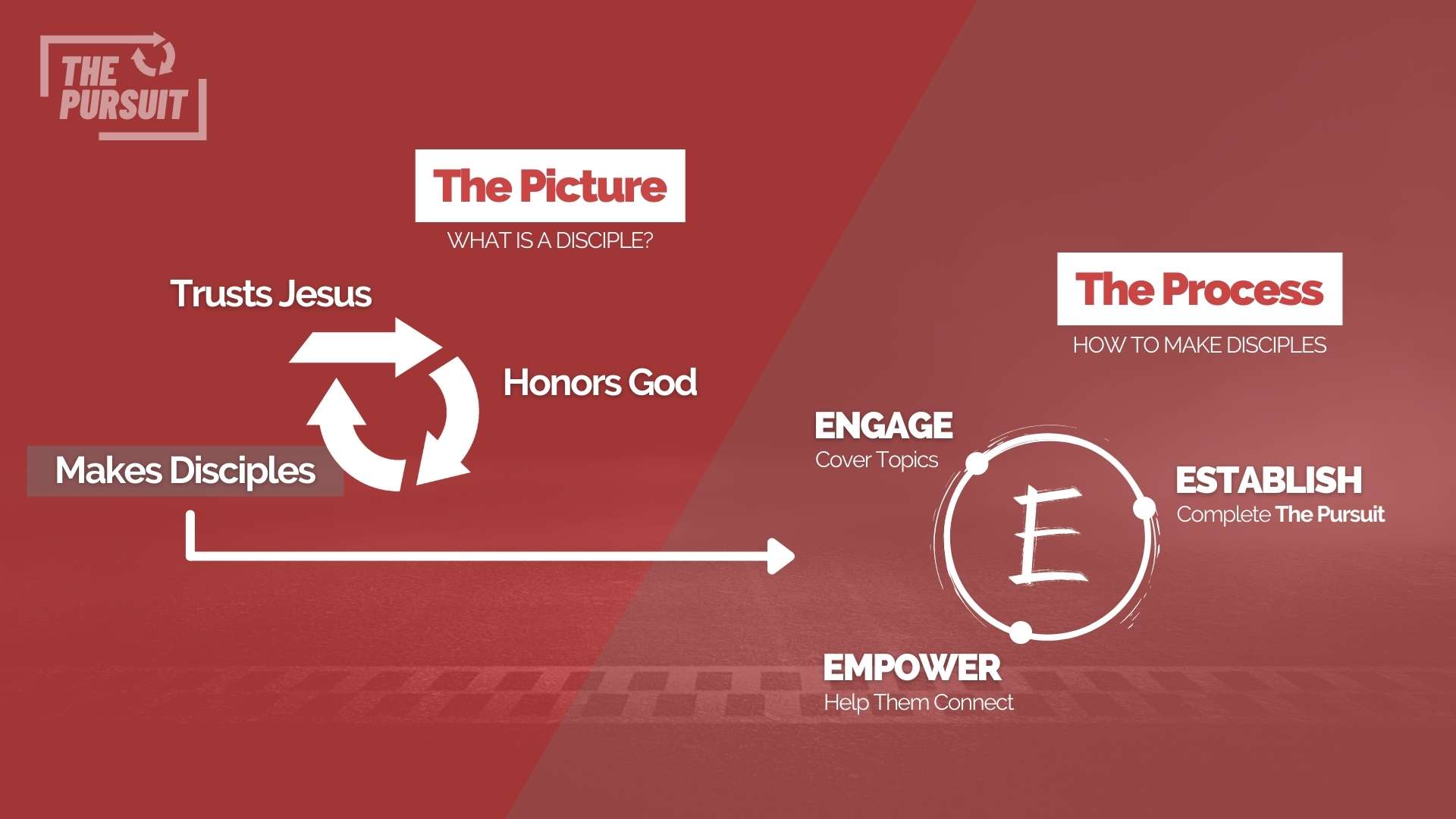
It’s the last part of that image that leads to the final step in the disciple-making process.
Step 3: Empower
Third, empower the person to become a disciple-maker. The final three lessons in The Pursuit are training topics, explaining the picture and process of discipleship. This means that once you’ve finished The Pursuit, you’re ready to empower the person you’re discipling to get in the game and start making disciples, too.
But they’ll probably need your help. Most people are intimidated by the thought of becoming a mentor and discipling someone. So you’ll have to convince them that they’re qualified, just like Jesus had to do with his disciples. And you’ll probably also have to help them get connected to someone else who needs a mentor. This is where the local church can come in. Ask a pastor where there’s a need, and then help make the handoff.
Engage, establish, and empower. The whole process is designed to make disciple-making a thing again. It’s the kind of generational discipleship that Paul described to Timothy:
2 Timothy 2:2 (NLT) You have heard me teach things that have been confirmed by many reliable witnesses. Now teach these truths to other trustworthy people who will be able to pass them on to others.
If you’re a Christian, Jesus wants you to make disciples. PursueGOD makes it easy. If you can have a conversation, you can make a disciple.
The Takeaway
Making disciples is the heartbeat of the Christian life and the most significant way you can spend your time. It starts with a simple “yes” to Jesus’s command and a willingness to be intentional with the people already in your life. By engaging, establishing, and empowering others, you can help them discover the life-changing power of Jesus and ensure the cycle of faith continues for generations to come.
What Are the Essentials for Disciple-making?
Helping someone else follow Jesus—what we call disciple-making—is the core mission of every believer. While it might feel intimidating or like something only pastors do, Jesus designed it to be a natural part of our lives.
At its heart, disciple-making is a conversation that leads to transformation. Here are the five essentials to keep in mind as you help others pursue God.
1. Commit to a Real Relationship
Discipleship isn’t a classroom lecture; it’s a relationship. You cannot effectively mentor someone if you don’t genuinely care about them. Jesus didn’t just give his disciples a syllabus; he ate with them, traveled with them, and loved them. If there is no connection, there is no influence.
John 15:12-17 “This is my commandment: Love each other in the same way I have loved you. There is no greater love than to lay down one’s life for one’s friends…”
2. Share the Right Truth at the Right Time
It is easy to get excited and want to dump every theological concept you know onto a new believer. However, effective disciple-making requires discernment. Pay attention to the specific struggles or questions the other person is facing. Don’t force your favorite topics; instead, listen to the Holy Spirit to know what truth they need to hear today.
1 Corinthians 2:14 “But people who aren’t spiritual can’t receive these truths from God’s Spirit. It all sounds foolish to them and they can’t understand it…”
3. Just Do Your Part, Not God’s
One of the biggest burdens in discipleship is feeling responsible for the other person’s spiritual growth. The truth is, you can’t make someone pursue God. Your job is to be a faithful guide, to show up, and to walk alongside them. God is the one who changes hearts. If they stall out or walk away, keep loving them, but remember that their journey is between them and the Lord.
4. Point It All to Jesus
The goal of making a disciple isn’t to make them a “better person” or a “mini-version of you.” The goal is to help them meet and follow Jesus. Every conversation, every piece of advice, and every study should ultimately point back to the life, death, and resurrection of Christ. He is the one who saves and sustains.
5. Pray, Pray, Pray
You cannot mentor someone effectively without talking to God about them. Prayer is where the heavy lifting happens. Keep a prayer journal and make a habit of praying for the specific needs of the people you are mentoring. Better yet, let them know you are praying for them—it builds trust and reminds them they aren’t alone.
The Takeaway
Disciple-making is simply one person helping another take their next step toward Jesus. By focusing on relationships, sharing timely truth, trusting God with the results, pointing to Jesus, and staying grounded in prayer, you can fulfill the Great Commission right where you are.
Find additional training topics in the #Mentors tab on this series page.
- Posts not found