
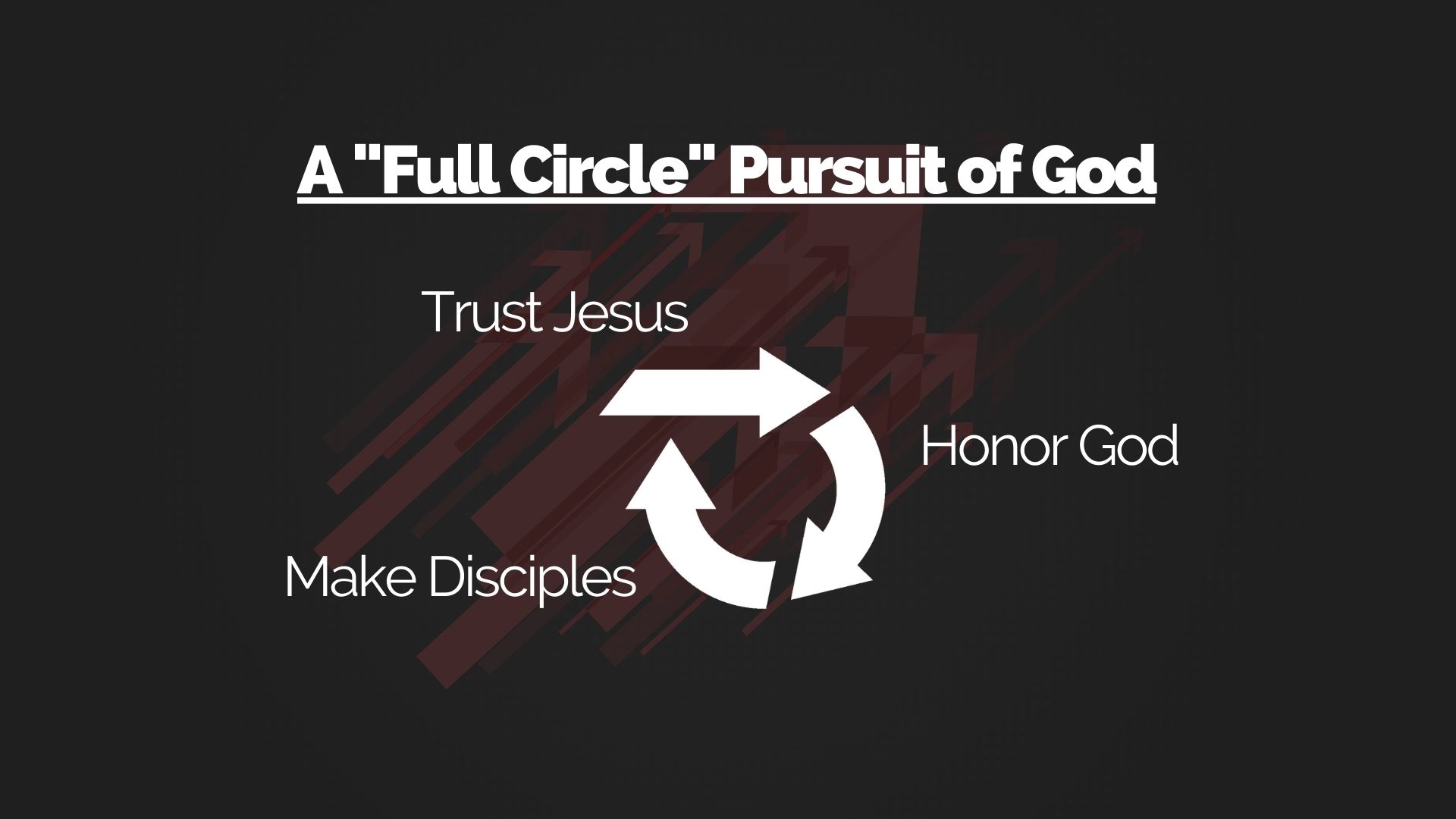
So you’re a Christian. Now what? Getting to your defining moment of faith is more than the end of your old life; it’s the beginning of a new one! Here’s how Paul said it to the church in Corinth: 2 Corinthians 5:17 This means that anyone who belongs to Christ has become a new person. The old life is gone; a new life has begun! Let’s put it in the context of our “full circle” picture of Christianity. Genuine faith (arrow one) leads to a new way to live our lives (arrow two). We’re not in charge anymore; now we want to find out what pleases God and do it (Ephesians 5:10). So what does this look like practically in our everyday lives? It would take a lifetime to explore this question fully, but the first answer is surprisingly simple. Read the New Testament and you’ll see that almost every new Christian took the same first step after coming to faith in Jesus: they got baptized. Baptism is the ancient Christian ritual of immersing someone in water as a symbol of Christ’s death and resurrection. In this lesson we’ll outline five things you need to know about it, and we’ll end with a simple conclusion: you should get baptized! Let’s start with the obvious: baptism doesn’t save you. Remember what we learned in the last lesson: we start a relationship with God by trusting Jesus, PERIOD. Baptism is important, and we’ll explain why in the next several points. But it is not required for salvation. Paul made this point clear enough in his letter to the Romans: Titus 3:5 [God] saved us, not because of the righteous things we had done, but because of his mercy. He washed away our sins, giving us a new birth and new life through the Holy Spirit. If baptism were required for salvation, then our salvation would be dependent in part on our own work. But Jesus did all of the work on the cross to save us! Consider the thief on the cross next to him (Luke 23:39-43), the one who professed his faith in Jesus and begged for his mercy. Jesus’ response was simple: “Today you’ll be with me in paradise.” The thief was moments away from death, and he had no time to get baptized. Not a problem. Just like the thief on the cross, we are saved by faith in the finished work of Christ. If baptism doesn’t save, then why do it? The obvious reason is this: Jesus said so. Matthew records one of his final commands to his disciples, known today as the “Great Commission”: Matthew 28:19 (NLT) Therefore, go and make disciples of all the nations, baptizing them in the name of the Father and the Son and the Holy Spirit. Jesus told his disciples to go make disciples, and he gave them very simple instructions about what to do next: baptize them. So that’s just what they did. Read the series of Acts for yourself, and pay attention to what happened after someone came to faith in Jesus. They got baptized. If you’ve put your faith in Jesus, you should get baptized. If somehow you missed the memo years ago, it’s not too late to obey. Get baptized because Jesus said so; that should be the only reason you need. The Christian life is all about honoring God, and it promises to be a journey filled with plenty of ups and downs. You’ll be challenged to submit to God’s way in the areas of relationships, sexuality, money, marriage, parenting, and more. You’ll be stretched to obey some things that don’t come naturally at first. But baptism is not like that. It’s one of the easiest steps you’ll be asked to take, and God has front-loaded it because he wants to give you an early win. Think about how money works. If you’ve got a bunch of debts to eliminate, conventional wisdom says to get rid of the smallest debt first. The reason for this is simple: the sooner you can check off one of your debts, the better you’ll feel about checking off all of your debts. Getting an early win will motivate you to tackle the next thing, and over time the psychological strategy will pay off. The Ethiopian eunuch understood this principle. Immediately after Philip shared the gospel with him, he was ready to exercise his “obedience” muscle. Acts 8:36 (NLT) As they rode along, they came to some water, and the eunuch said, “Look! There’s some water! Why can’t I be baptized?” The eunuch was baptized right away, and he certainly continued to honor God when he got back to his homeland of Ethiopia. If you haven’t taken this first step – as easy as it is – then what other steps are you unwilling to take? Why not be baptized? Check that off so you can move on to even bigger things. When we get baptized, we’re publicly identifying ourselves in a couple of important ways. Paul explained it like this to the Christians in Rome: Romans 6:3 (NLT) Or have you forgotten that when we were joined with Christ Jesus in baptism, we joined him in his death? Two things jump out in this verse. First, Paul says “we”. He was baptized when he came to faith, and so was every other Christian in Rome. Baptism, then, was an important act of unity. It’s not about membership in a local church; it’s much greater than that. Through baptism, you join a movement of Christians across the world and throughout history. You’re doing the same thing that Paul, James, John, and even Jesus did (Mathew 3:13-17). And if your grandparents were Christians, they did it too. Someday your great-grandkids may join you in baptism. That’s a powerful thought. But baptism is not just about identifying with other believers; we also identify with Jesus. Paul said that we “joined him in his death.” Like everything else in the Christian life, baptism is focused on the death and resurrection of Jesus. It’s not an empty religious ritual; it’s a reminder that Jesus is at the center of our lives. In simplest terms, baptism is an external symbol of something that has already happened to us on the inside. Remember: baptism doesn’t save you. But the act of baptism is a physical reminder to us and others of a deeper spiritual reality. When couples get married, they usually exchange wedding rings. Those rings are important, but they’re just symbols of the bigger thing: vows. Just as taking rings off doesn’t nullify wedding vows, failing to get baptized doesn’t nullify faith. But why not wear this important symbol? When you make the choice to go down into the waters of baptism you are memorializing the death of Jesus. When you come up out of the water you are signifying his resurrection – along with your new life in Christ. That’s how Paul described it: Romans 6:4 (NLT) For we died and were buried with Christ by baptism. And just as Christ was raised from the dead by the glorious power of the Father, now we also may live new lives. So, have you trusted Jesus for salvation? Are you ready to start honoring God with your life? The first step is not complicated. Don’t overanalyze it. Get baptized.
Baptism Doesn’t Save
Simply Obey
An Early Win
An Act of Identification
An Outward Symbol
- Baptism doesn’t save you; we start a relationship with God by trusting Jesus and his finished work on the cross. Romans 3:22
- Jesus said to get baptized, and that’s the main reason we should do it! Matthew 28:19
- Baptism is an early act of practical obedience – and it’s one of the easier commandments. Acts 8:36
- Baptism is an act of identification – both with Christ and his church. Romans 6:3
- Baptism is an outward symbol of an inward reality. Romans 6:4
- Read the talking points above as a group, including scripture references. What are your initial thoughts about these points or about the podcast lesson (see audio above)?
- What has your understanding of baptism been up to now? Is there anything in this chapter that surprised or confused you? Explain.
- Read Matthew 28:19. Why do you think some people become Christians and yet never get baptized?
- Baptism is one of the easiest steps of obedience. Make a list of some of the harder things you’ll have to do as a Christian.
- Read Romans 6:3-4. What does baptism symbolize? What are you declaring to the world when you do it?
- Have you been baptized? If so, when – and was it for the right reasons? If not, are you ready to do it? Why or why not?
See Also:
- Why Should A Christian Get Baptized?
- Are You Ready to Get Baptized?
- Should You Get Baptized Again?
- What Are the Top Five Bible Verses on Baptism?
- Should I Baptize My Infant?
- When Should We Baptize Our Kids?
- Am I Qualified to Baptize Someone?
- What Does the Bible Say about Baptism?
- What Is Baptism with the Holy Spirit? (Acts 2:1-13)
- Jesus Gets Us: Understanding His Baptism and Temptation (Mark 1:9-15)
- Does Baptism Save?
- Understanding Baptism
- Common Baptism Questions
- 5 Facts About Water Baptism | Christian Basics for Jr. High #5
- The Baptism of Jesus
Is My Child Ready to Get Baptized?
- Baptism is an outward declaration of an inward faith. Salvation happens in the heart, not in the water. Colossians 2:12, Galatians 3:26
- A child should understand the gospel in simple, personal terms—who Jesus is, what He did, and why they need Him. Romans 10:9
- Early signs of discipleship include prayer, questions, and conviction about sin. We’re looking for evidence of spiritual life, not perfection. 2 Corinthians 5:17
- Baptism must be a child’s own decision, not motivated by parents or peers. 1 Corinthians 11:28
- Kids should understand what baptism represents: dying to the old life and rising to new life in Christ. Romans 6:4
- Age isn’t the determining factor—understanding and personal faith are.
- If a child isn’t ready, parents can keep discipling through ongoing conversations, modeling faith, and trusting God’s timing.
- Read the talking points above as a group, including scripture references. What are your initial thoughts about these points or about the podcast lesson (see audio above)?
- How would you explain the difference between salvation and baptism to a child?
- What signs of early spiritual growth have you seen in children—your own or others?
- Why is it important for baptism to be a child’s decision rather than something parents push for?
- How can parents wisely discern whether their child understands the gospel clearly?
- What are healthy ways to respond when a child wants to be baptized but isn’t quite ready?
- What practical next steps can a family take when their child truly is ready for baptism?
A Father Son Convo on Baptism
- Baptism might seem weird – like swimming at church. But it’s actually a really cool symbol that we believe in Jesus: his death (going into the water) and his resurrection (coming out to the water).
- Does baptism save us? Nope, getting baptized doesn’t save us from our sins. Jesus saves us from our sins the moment we put our trust in him. Baptism is what we do after we’ve trusted in Jesus because we want to tell the whole world that we belong to him.
- Why should we get baptized? Jesus told us we should get baptized. And, when Jesus tells us to do something, we should do it! The other reason is because baptism is a symbol for something that happens in our lives when we meet Jesus. Romans 6:4, Colossians 2:12
- Have you ever seen someone get baptized? What was it like?
- Read Romans 10:9-10. Who saves us? What do we need to do to be saved? Have you asked Jesus into your heart?
- Read Matthew 28:18-19. Who told us we should get baptized?
- Read Colossians 2:12. What does going into the water mean? What does it mean when we come out of the water?
- Are you ready to get baptized?
- Why Should A Christian Get Baptized?
- Are You Ready to Get Baptized?
- Should You Get Baptized Again?
- What Are the Top Five Bible Verses on Baptism?
- Should I Baptize My Infant?
- When Should We Baptize Our Kids?
- Am I Qualified to Baptize Someone?
- What Does the Bible Say about Baptism?
- What Is Baptism with the Holy Spirit? (Acts 2:1-13)
- Jesus Gets Us: Understanding His Baptism and Temptation (Mark 1:9-15)
- Does Baptism Save?
- Understanding Baptism
- Common Baptism Questions
- 5 Facts About Water Baptism | Christian Basics for Jr. High #5
- The Baptism of Jesus
